
Colorful favicon for AI Quick Bytes, a futuristic AI media site.
update
AI Quick Bytes
update
  • Home
  • Categories
    • AI News
    • Open AI
    • Forbes AI
    • Copilot
    • Grok 3
    • DeepSeek
    • Claude
    • Anthropic
    • AI Stocks
    • Nvidia
    • AI Mishmash
    • Agentic AI
    • Deep Reasoning AI
    • Latest AI News
    • Trending AI News
    • AI Superfeed
February 27.2025
2 Minutes Read

Agentic AI Tools Market Set to Boost Technology by USD 419.03 Bn

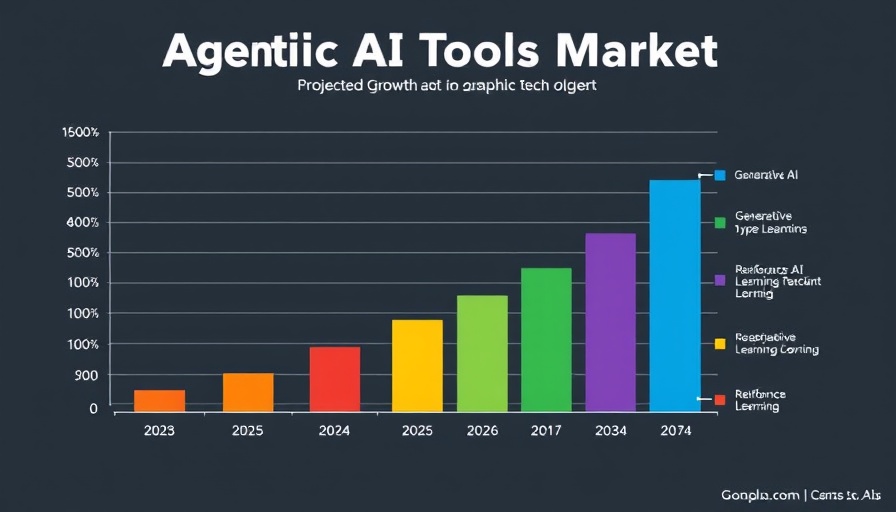
Projected growth of Agentic AI Tools Market 2025-2034 graph.

AI Tools Set to Revolutionize Technology Landscape

The Agentic AI Tools Market is surging ahead, projected to skyrocket to an astonishing USD 419.03 billion by 2034, more than 67 times its value of USD 6.2 billion in 2024. This represents a remarkable compound annual growth rate (CAGR) of 52.4% during the period from 2025 to 2034. This rapid growth is primarily attributed to the soaring adoption of AI technologies across various sectors, with agentic AI tools paving the way towards enhanced operational efficiency and streamlined decision-making.

Understanding Agentic AI and Its Applications

Agentic AI tools consist of systems powered by artificial intelligence that autonomously execute tasks, often involving complex processes such as decision-making, data analysis, and predictive analytics. Industries including finance, healthcare, retail, and logistics greatly benefit from these tools. For example, in healthcare, AI tools are instrumental in automating diagnostics and patient management. Similarly, in finance, they provide enhanced fraud detection and risk assessment capabilities.

Why North America Leads the Charge

North America held a dominant position in the agentic AI tools market in 2024, capturing 35.2% of the total market revenue. The U.S. alone posted revenues of USD 1.74 billion and is experiencing a growth rate of 51.6%. The concentration of advanced technology players, substantial R&D investments, and supportive government policies have bolstered North America's leadership in AI adoption.

Emerging Trends and Market Drivers

Several key trends are driving this explosive growth in agentic AI. There’s a rising demand for cloud-based AI solutions, facilitating not just scalability but also cost-effectiveness for small and medium enterprises (SMEs). Moreover, the ability of these tools to provide real-time analytics and data-driven decision-making makes them increasingly important in a rapidly digitizing world.

Challenges and Considerations Ahead

Despite its expansive growth, the agentic AI tools market faces challenges such as trust and security concerns. Organizations implementing these systems must navigate issues surrounding data privacy and the ethical implications of AI autonomy. Investing in robust security measures while addressing these ethical dimensions is crucial for maintaining public trust in AI technologies.

What's Next for Agentic AI?

The future holds immense potential for agentic AI tools, with emerging markets in Asia-Pacific expected to fuel further growth. As countries like China and India continue to advance their digital infrastructures, integrating AI tools becomes imperative. Organizations are encouraged to explore opportunities, innovate solutions, and invest strategically in AI technologies to remain competitive in their respective sectors.

Conclusion: Embrace the AI Revolution

As the agentic AI tools market continues its rapid expansion, staying informed about technological advancements and market dynamics is vital for AI enthusiasts and businesses alike. With growing investments in AI solutions and increasing integration across industries, now is the perfect time to dive into the world of agentic AI tools. The transformative potential of AI can considerably enhance operational efficiency and future-proof businesses amidst evolving market demands.

AI Superfeed

3 Views

Write A Comment

*
*
Please complete the captcha to submit your comment.
Related Posts All Posts
05.23.2026

Unpacking Snowflake's AI Data Cloud Integrations: Governance Impact Explained

Update Unpacking Snowflake's New AI Data Cloud Integrations As the landscape of artificial intelligence evolves, the advent of Snowflake’s AI Data Cloud integrations raises critical questions about governance. Designed to harness the power of AI while ensuring robust data management, these integrations may serve as both a boon and a challenge for organizations. This article delves into what these changes mean for data governance and offers actionable insights for AI enthusiasts eager to understand the implications. What Are Data Governance and Its Importance? Data governance in an AI context encompasses the policies and practices that ensure data quality, compliance, and security. For example, without solid governance, organizations risk operational hiccups, unreliable AI model outputs, and potential legal ramifications due to non-compliance with regulations like GDPR. As organizations increase their reliance on data-driven insights, effective governance becomes crucial to not only mitigate risks but also to build trust among users and stakeholders. Diving Into Snowflake's AI Data Cloud Features The new integrations within Snowflake’s AI Data Cloud focus on improving data accessibility and usability while maintaining tight governance controls. Key features include: User Management & Access Control: Ensures that only authorized personnel can access sensitive information. Detailed role-based access controls help prevent unauthorized data exposure. Data Masking: Allows organizations to hide sensitive data when running queries, ensuring privacy and compliance. Data Lineage Tracking: Provides visibility into how data flows through the organization, enabling audit readiness and governance compliance. These features collectively enhance Snowflake's efforts to deliver a secure and flexible data management environment that empowers users without compromising data governance. The Challenges of Implementing Effective Data Governance Despite its robust features, integrating new AI capabilities introduces complexities. Organizations often face challenges such as: Complexity of the Environment: With advanced features, proper governance requires a nuanced understanding of Snowflake’s architecture to effectively manage data flows and maintain compliance. Scalability Issues: As data volumes grow, enforcing governance measures can become cumbersome, potentially slowing down performance. Integration Hurdles: Collaborating with existing systems introduces challenges in maintaining consistent governance protocols across different platforms. By recognizing and addressing these hurdles, organizations can take strategic actions to fortify their data governance frameworks while leveraging AI technologies. Future Predictions: The Road Ahead for Snowflake The future looks promising for Snowflake as organizations explore AI-driven solutions, but the path is not without its bumps. Rapid advancements in AI may demand quicker adaptations in governance structures to liaise with evolving technologies. Equipped with clear governance frameworks, organizations can transition seamlessly from conventional data management to agile, AI-centric models that prioritize data integrity and compliance. Conclusion: Embracing Change with Caution Snowflake’s new AI Data Cloud integrations can undoubtedly shift the narrative around data governance, potentially clarifying its framework while posing new challenges. For AI lovers looking to dive deeper, it is essential to stay updated with ongoing trends, regulations, and best practices in data governance as these dynamics shift. As the importance of effective data governance rises in conjunction with AI advancements, embracing these changes with a proactive approach will drive innovation and foster a robust data culture in your organization.

Terms of Service

Privacy Policy

Core Modal Title

Sorry, no results found

You Might Find These Articles Interesting

T
Please Check Your Email
We Will Be Following Up Shortly
*
*
*